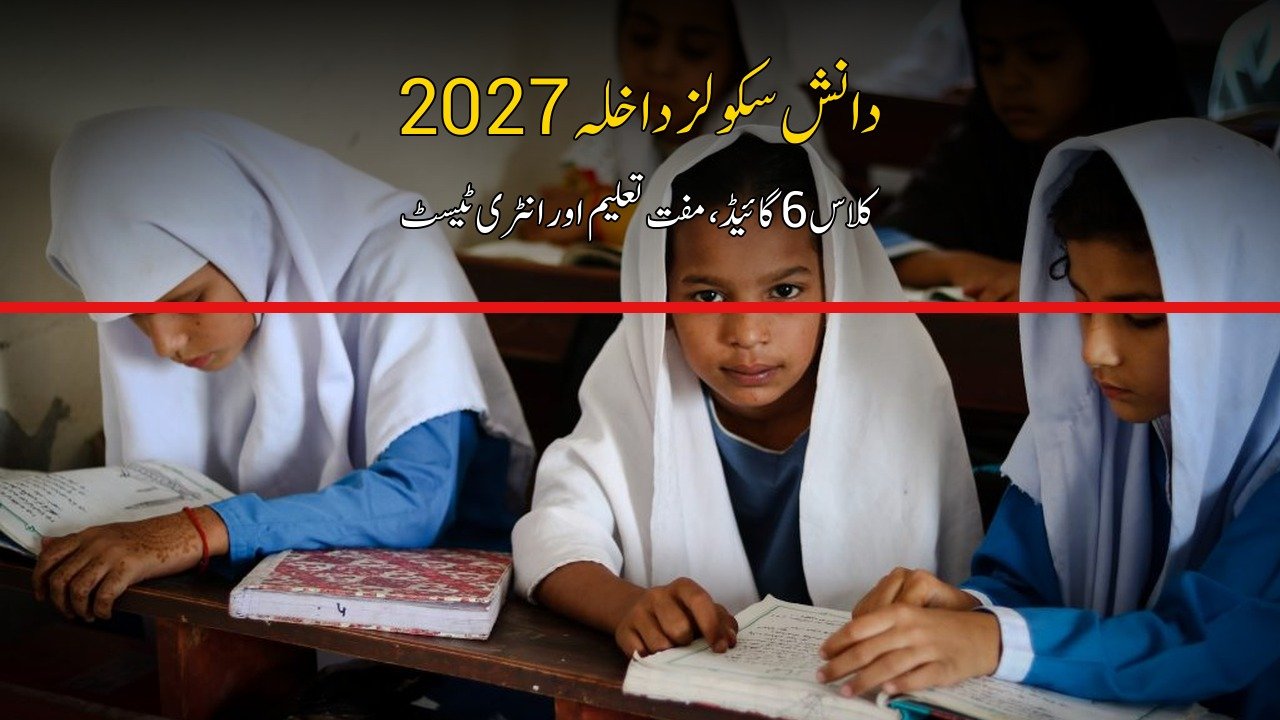
Punjab Daanish Schools have announced Class 6 admissions for the 2027 academic session — a significant educational opportunity for eligible boys and girls across Punjab. The objective of this admission program is to provide quality education to deserving students, particularly children from low-income families and disadvantaged communities.
According to the announced admission policy, most seats are reserved for free residential education, while a smaller number of seats fall under the self-finance category for families able to pay monthly charges.
The Daanish Schools network was established to bring quality schooling within reach of children who would otherwise never access it. For parents evaluating options for the coming session, need-based support programs such as the KPK EEF Scholarship 2026-27 — Rs. 8,000 for children of KP Education Department employees — may also be worth reviewing.
Daanish Schools Admission 2027: Important Information
- Institution: Punjab Daanish Schools
- Session: 2027
- Class: Class 6
- Eligible students: Boys and girls
- Previous class: Class 5 passed
- Boys’ age limit: 10 to 12 years
- Girls’ age limit: 10 to 13 years
- Entrance test: Written examination (100 marks)
- Free education seats: Reportedly 90%
- Self-finance seats: Reportedly 10%
Confirm the admission schedule, the age calculation date, income conditions, and the fee structure with the relevant campus, as these details can vary.
Who Can Apply?
- The applicant must have completed Class 5 from a recognized school — keep the result card or completion certificate ready.
- Boys must be between 10 and 12 years of age; girls between 10 and 13 years (reported limits).
- Age will be calculated as of the official cutoff date — verify this date carefully, since even a small difference can affect eligibility.
Who Can Get Free Education?
The mission of Daanish Schools is to bring quality schooling to children who would not ordinarily get the opportunity. The free education category is for families facing financial hardship. Preference may be given to:
- Children who have lost their father or the family’s earning member.
- Students from very low-income households.
- Children whose parents’ employment is unstable or who face severe financial difficulties.
- Children who dropped out of school because the family could not afford it.
- Children from remote, underdeveloped rural areas.
- Children living in unsafe or temporary housing.
Some applicants may be asked to provide evidence of the family’s financial situation. The available information mentions a Rs. 15,000 monthly household income benchmark, but do not treat it as final without confirming it from the official notification.
Entry Test Syllabus 2027
Applicants for Class 6 will take a 100-mark written entrance test covering English, Mathematics, General Science, Urdu, and IQ:
- English: 35 marks — Grammar, vocabulary, reading comprehension
- Mathematics: 20 marks — Arithmetic, word problems, basic calculations
- General Science: 15 marks — Basic science concepts from the primary classes
- Urdu: 10 marks — Grammar, sentence structure, comprehension
- IQ: 20 marks — Logical reasoning, patterns, analytical thinking
- Total: 100 marks
The distribution of marks is based on the available information — confirm any changes against the official syllabus.
How to Prepare for the Entry Test
- Revise English daily: grammar, vocabulary, sentence formation, and reading comprehension.
- Practise mathematics: multiplication, division, fractions, and Class 5 word problems — learn to solve them correctly rather than memorizing answers.
- Revise important General Science concepts from the primary syllabus.
- Improve Urdu reading and grammar through regular practice.
- For the IQ section, practise patterns, number sequences, and logical puzzles.
- Take timed practice tests and review every wrong answer to understand the mistake.
Consistent daily practice over several weeks is far more effective than last-minute cramming, especially for the IQ and mathematics sections.
Free Seats vs Self-Finance Seats
- Free education category: 90% of seats (reported) — tuition and residential charges are free; this may include tuition, boarding, meals, uniform, books, and basic health monitoring.
- Self-finance category: 10% of seats (reported) — monthly fee of Rs. 20,500 (reported); confirm admission fee, security deposit, and other charges with the campus.
One campus section reports an intake of 110 students, with 99 free and 11 self-finance seats — confirm the actual numbers with the campus, as intake varies.
Required Documents
- Four recent passport-size photographs
- Attested Class 5 result card
- Copy of the father or legal guardian’s CNIC
- NADRA B-Form or birth certificate
- Income-related documents (for the deserving category)
Copies must be clear, and names and dates must match across all documents. Mismatched spellings between the B-Form and the result card are a common and avoidable cause of processing delays.
How to Apply
- Obtain the admission form from the official portal or the campus — first confirm which method is currently available.
- Enter the student’s personal, academic, and guardian information accurately.
- Attach the required documents.
- Submit the form before the deadline according to the campus’s official instructions — keep a copy and the receipt safe.
- Follow the school’s instructions for test dates, centres, and roll number slips — do not trust unverified dates circulating on social media.
Selection Process
- Stage 1: Written entrance test — merit-based shortlisting
- Stage 2: Verification of family information — particularly for the free education category
- Stage 3: Medical fitness assessment
- Stage 4: Final admission — depends on merit, verification, medical fitness, and available seats
Merely being eligible to apply does not guarantee selection. Competition for free seats is typically intense, so thorough preparation for the written test is the single most important factor a family can control.
Frequently Asked Questions
When will Daanish Schools Class 6 admissions 2027 open? Admissions have been announced — confirm the application opening and closing dates from the school’s official notification.
What is the age limit? 10 to 12 years for boys and 10 to 13 years for girls (reported).
Is the education really free? Free residential education is reported for 90% of seats in the deserving category — confirm the facilities with the campus.
What is the self-finance fee? According to the available information, Rs. 20,500 per month — verify with the campus.
Related Guides for Students and Parents
- NAVTTC Advisory for Students — verify your training institute before taking admission; see the full list of recognized bodies.
- CM Punjab Youth Games 2026 — registration, eligibility, and schedule for Punjab’s youth games; check how to apply.